UAV Battery
SUJOR is committed to delivering high-performance, cost-effective UAV battery solutions.
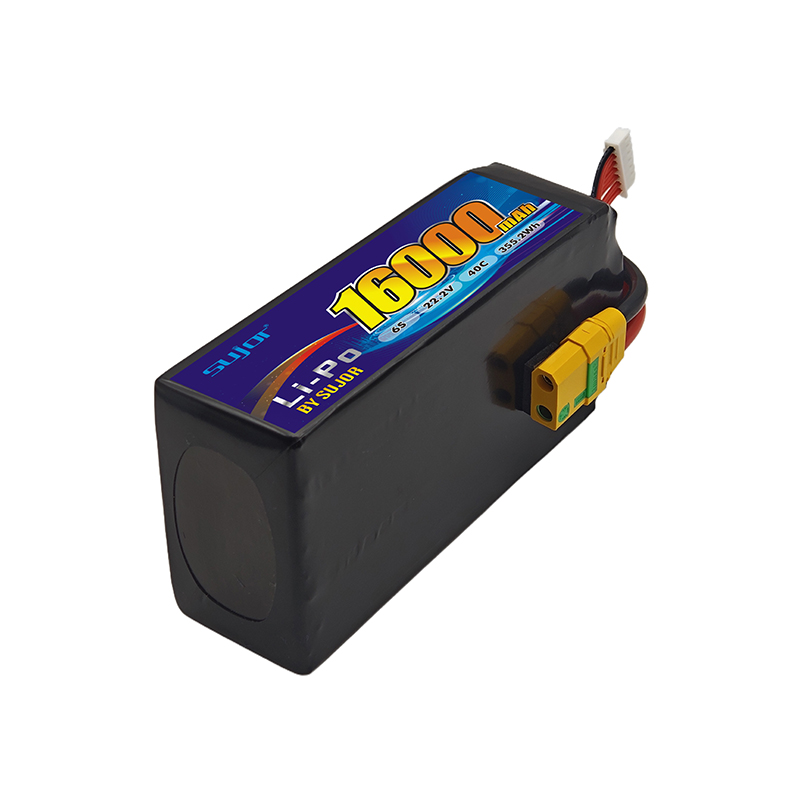
Product Introduction:
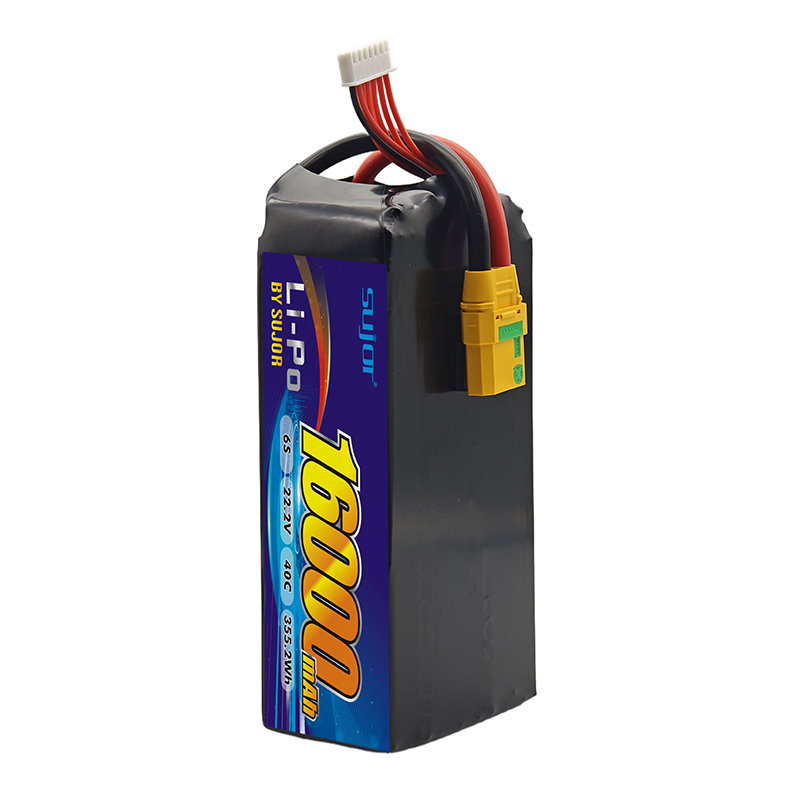
SUJOR 16000mAh 22.2V 40C 6s1p Lipo battery pack with XT90S plug is specially made for UAVs. It has big capacity and 40C high rate. It is able to provide big power for UAV. So it could assure the longest flight time and make your aerial equipment safe. Moreover, customized battery voltage, capacity, temperature and discharge rate are available.
Share
Basic Specification
|
Item |
Rating |
Remark |
|
Model |
SUJOR-22.2V 6s1p 16000mAh 40C |
61*80*185mm(H*W*L) |
|
Nominal capacity |
16000mAh |
Standard discharge(1C5A) after Standard charge |
|
Nominal voltage |
22.2V |
|
|
Cut-off charge voltage |
25.2V |
|
|
Cut-off discharge voltage |
18.0V |
|
|
Configuration |
6s1p |
|
|
Weight |
Approx: 1815g |
|
|
Anode material |
LiCoO2 |
|
|
Standard charge |
0.2C CC(constant current) charge to 25.2V,then CV(constant voltage 25.2V)till current decline to ≤0.01C |
Charge Time : Approx 7.0h |
|
Max. constant charging current |
16000mA(1C) |
|
|
Standard discharge |
Discharge at 1C5A to 18.0V |
|
|
Max. continuous discharging current |
640A(40.0C) |
|
|
Operating temperature |
Charge 0~+45ºC |
|
|
Discharge -20~+60ºC |
|
|
|
Storage temperature |
-10~+55ºC≤1 month |
|
|
-10~+45ºC≤3months |
|
|
|
-10~+25ºC≤12months |
|
|
|
Storage humidity |
45-75%RH |
|
|
Charge Connector |
White JST-XH 7P |
|
|
Discharge Connector |
Yellow XT90S |
|
Key Features
Explosion-Proof Spark Prevention
Large capacity, suitable for long-range flights with stable performance
Stable Automatic Stacking Technology
High discharge rate and excellent compatibility
High energy density, tailored for various types of drones
Top-quality and safe SUJOR Series batteries pass rigorous testing
7*24-hour after-sales service
Main Application
Agriculture spraying drone
Land surveying drones
Police drones
eVTOL
Delivery drone
Inspection drone
Photography drones
Construction drone
Mining drones
Fire-fighting drone
Fixed wing UAV
Small Agricultural Drones
Light Multirotor Platforms
RC Toy Drones
Hybrid Spraying and Aerial Photography Drones
Teaching/training drones
Certification
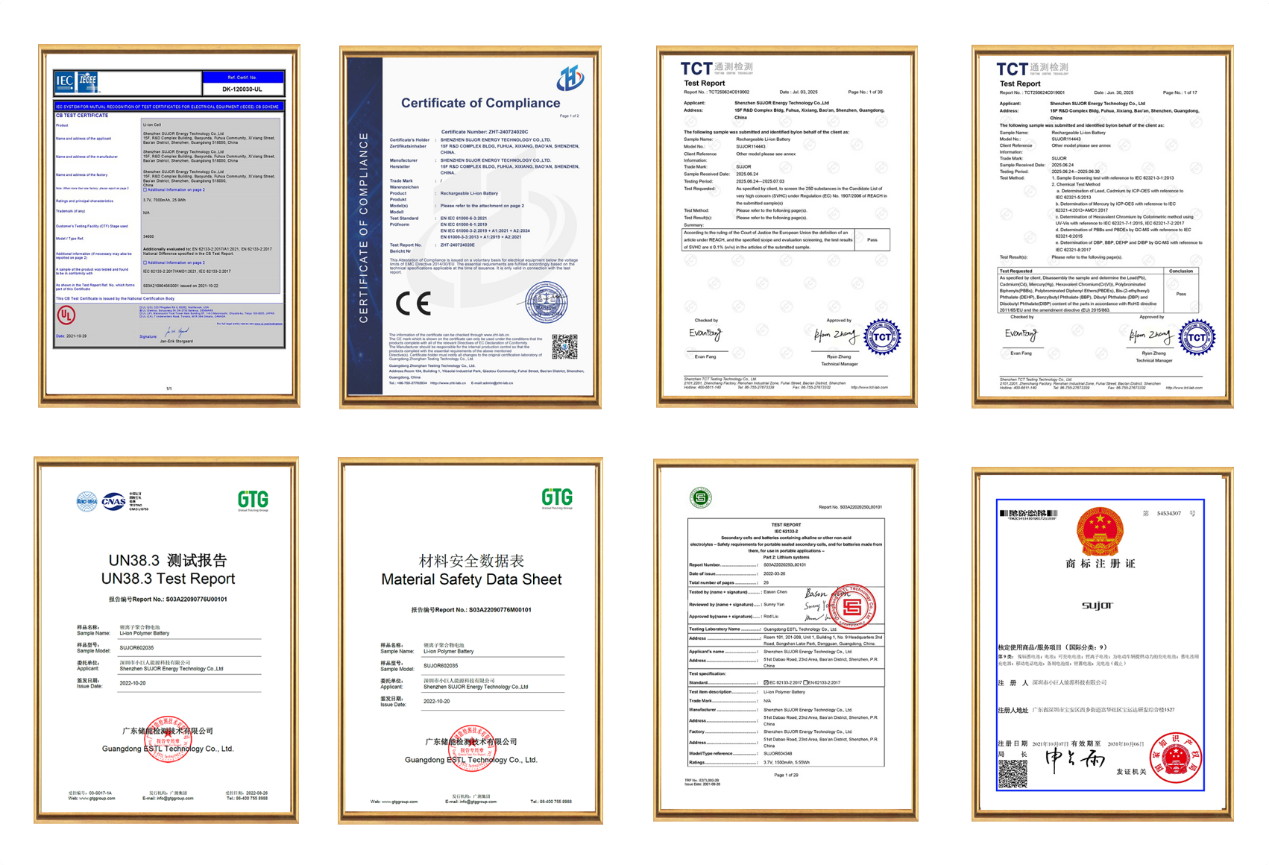
Our factory has been approved by ISO9001&ISO14001. And most of our products have passed CB, IEC62133, CE, RoHS, REACH, UN38.3, ect.
FAQ
Q:
What type of battery will be used for drones?
A:
The type of battery used for drones is overwhelmingly High rate Lithium Polymer (LiPo) batteries. High C-rate Lipo battery can deliver massive burst of current needed for takeoff, maneuvering and high-speed flight, ect. Moreover, Lithium polymer batteries are lightweight and have high energy density, providing drones a good amount of power which is critical for flight time. And Lipo batteries can be shaped into different dimensions that fit efficiently into drone bodies.
Q:
How to choose a battery for your drone?
A:
Selecting the right battery for your drone involves considering multiple factors to ensure optimal performance and compatibility. Here is a guide to choosing the appropriate battery:
Voltage (V):
Refer to your drone’s specifications to determine the required voltage. Most drones are powered by 3.7V (1S), 7.4V (2S), 11.1V (3S), 14.8V (4S), or 22.2V (6S) batteries.
Capacity (mAh):
The battery’s capacity determines how long your drone can fly. Higher capacity batteries generally offer longer flight times but also add weight. It’s important to find the right balance between flight time and weight to meet your needs.
Discharge Rate (C-rating):
The discharge rate indicates the amount of current the battery can deliver. A higher C-rating is suitable for drones that require high power output, such as racing drones or those equipped with powerful motors.
Q:
How long would a drone battery last?
A:
The lifespan of a drone battery can vary depending on several factors, including maintenance, frequency of use, as well as charging and storage practices. Generally speaking, a well-maintained drone battery can be recharged for 100 to 300 cycles. With proper care, some batteries may even last longer. Following the manufacturer’s guidelines for charging, storing, and using the battery is key to extending its service life.
Q:
How to extend drone battery’s lifespan?
A:
To extend the service life of your drone battery, please follow these recommendations:
Avoid overcharging: Remove the battery from the charger immediately once it is fully charged to prevent overcharging, which can damage the battery.
Avoid deep discharging: Try not to fully deplete the battery before recharging. It is recommended to recharge when the remaining capacity is between about 20% and 30%.
Store at the correct voltage: Keep the storage voltage at approximately 3.7 volts per cell, which is the optimal storage voltage for most lithium polymer (LiPo) batteries. This helps prevent capacity degradation over time.
Store in a cool, dry place: Keep batteries in a cool and dry environment, away from direct sunlight and extreme temperatures. High temperatures can accelerate battery aging.
Use the correct charger: Use a charger specifically designed for your particular drone battery to ensure safe and efficient charging.
Balance charge regularly: If your battery is a lithium battery, perform balance charging periodically to ensure all cells charge evenly. This helps extend the battery's lifespan.
Inspect regularly: Regularly check the battery for any signs of damage or swelling. If you notice any issues, stop using the battery immediately and dispose of it properly.
Avoid over-discharging during storage: If you plan to store the battery for an extended period, be sure to check its voltage regularly. If the voltage drops below the recommended storage level, recharge it.
Q:
What is the longest run time for the battery on a drone?
A:
The maximum battery runtime on a drone can vary depending on the drone's size, weight, and battery capacity. Generally, consumer drones offer flight times ranging from about 10 to 30 minutes on a single battery charge. However, some professional drones, such as those used for industrial or military purposes, can achieve much longer flight times—from 1 hour to several hours. These drones typically use larger batteries or alternative power sources to enable extended flight durations.
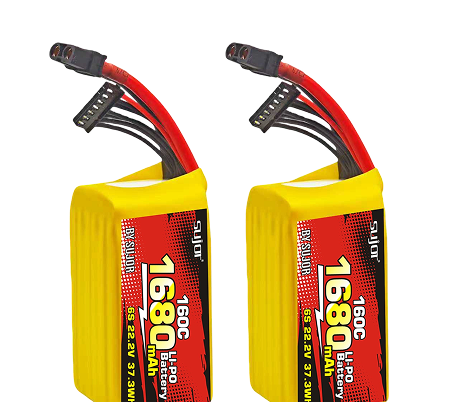
SUJOR aims to provide customers tailored lithium ion battery packs. We could not only provide customers with customized services for individual components such as battery cell, BMS and battery structure, but also offer optimal battery integrated solutions (cell+BMS+structure) based on customer’s detailed requirement.