UAV Battery
SUJOR is committed to delivering high-performance, cost-effective UAV battery solutions.
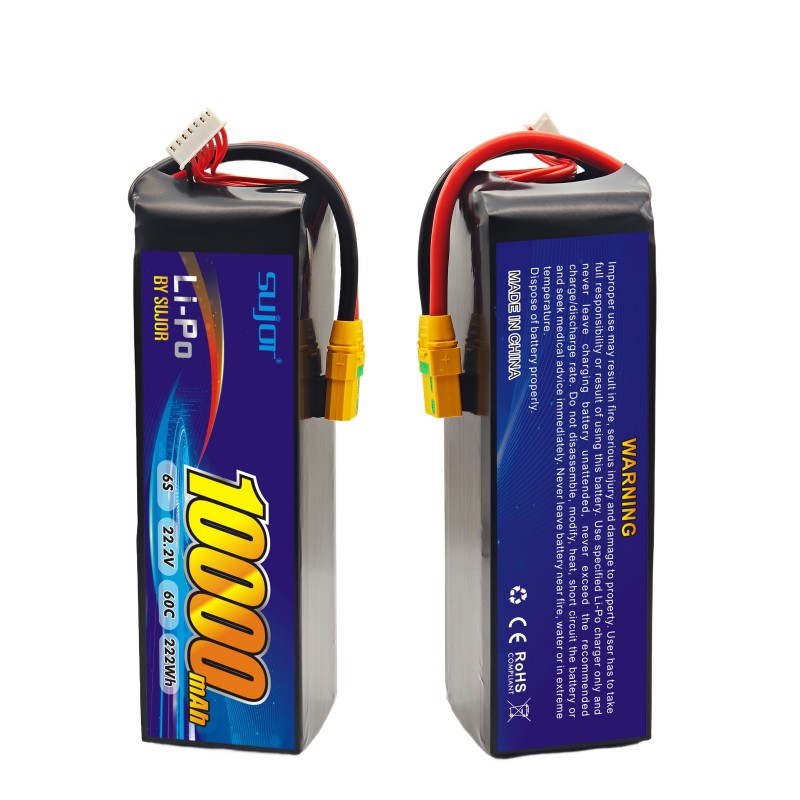
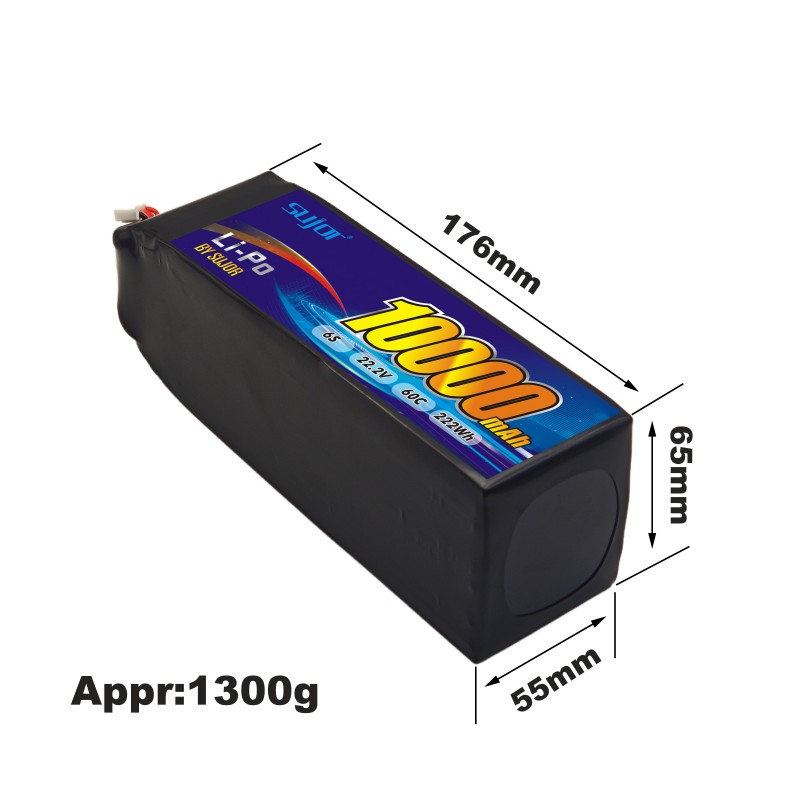
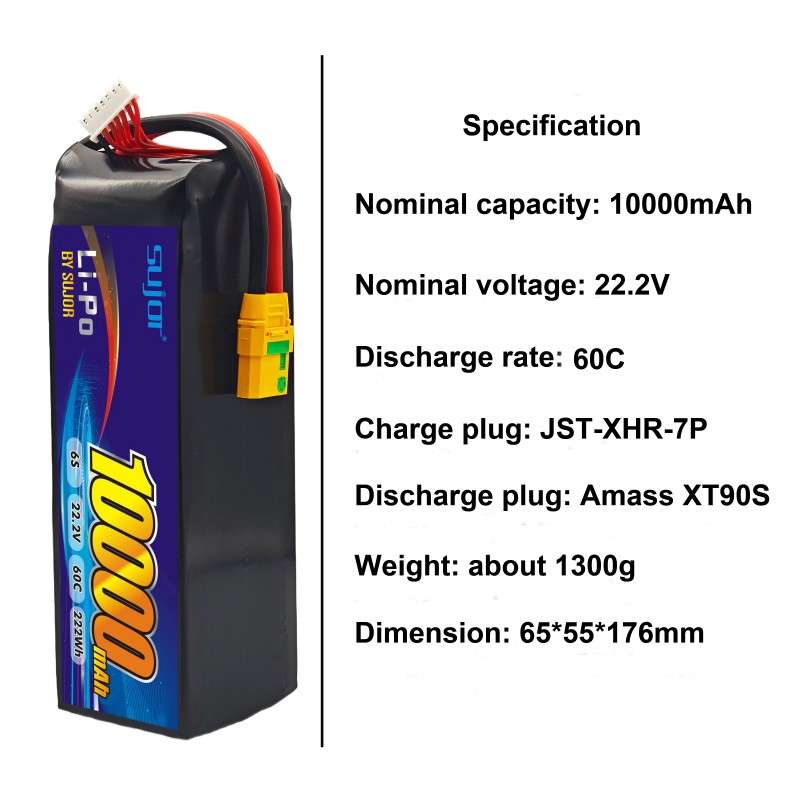
Product Introduction:
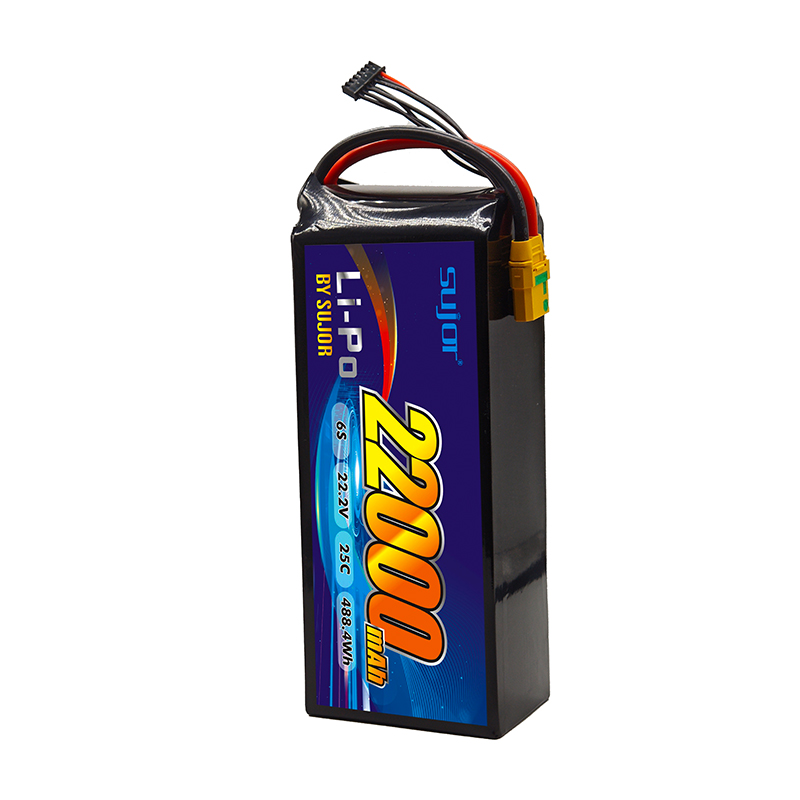
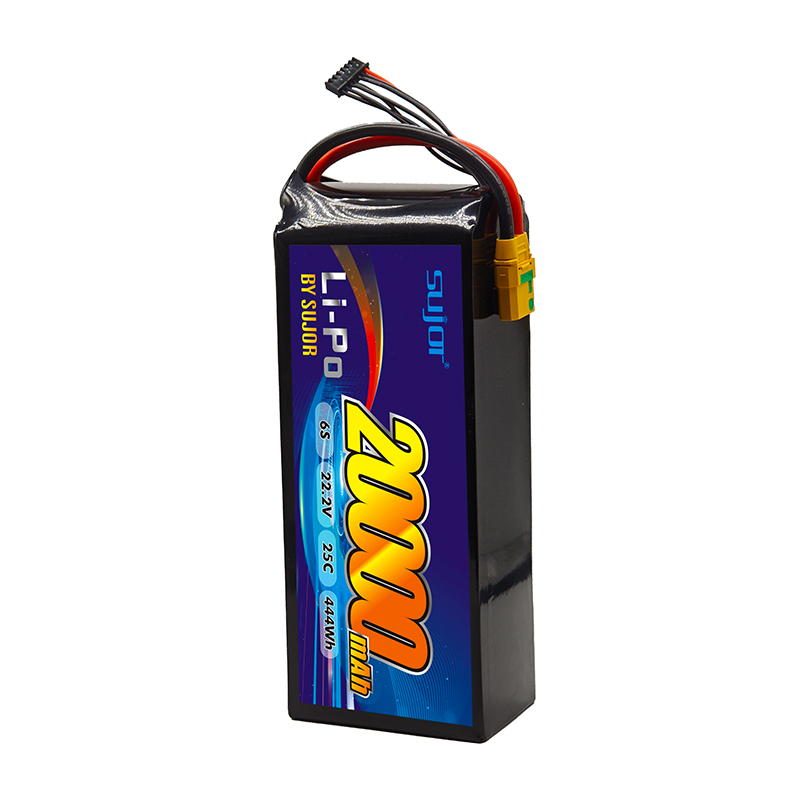
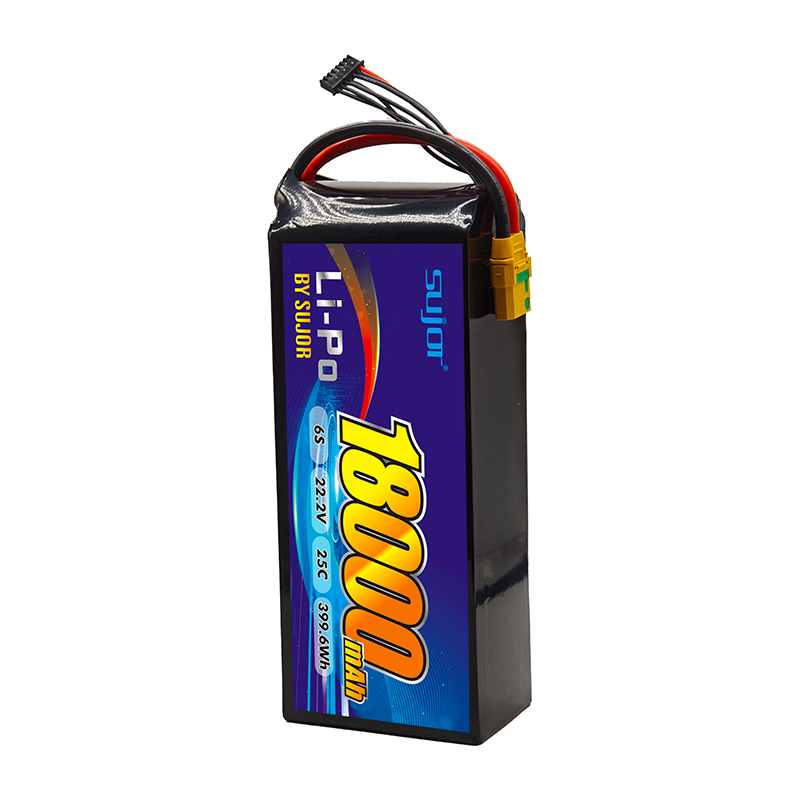
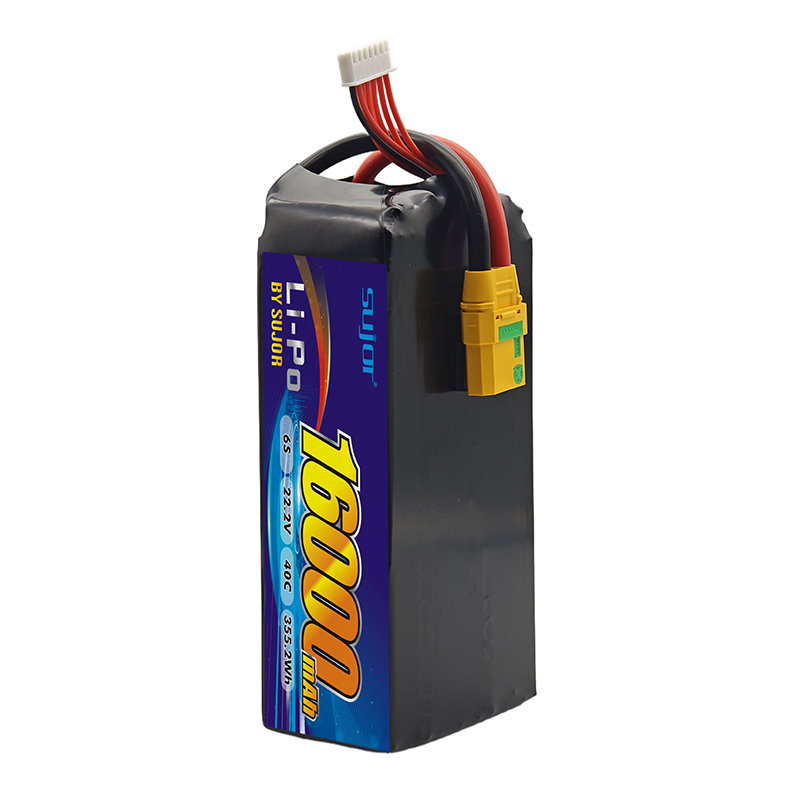
SUJOR 22.2V 6S1P 10000mAh 60C rechargeable drone battery is engineered for hybrid spraying and aerial photography drones, teaching/training drones, lighting showing drones, mapping drones, cleaning drones and other industry drones or UAV or eVTOL. The discharge connector could be customized as AS150, XT150, XT90-S, ect. It is equipped with smart BMS to make sure the battery works long and safely.
Share
Basic Specification
|
Item |
Rating |
Remark |
|
Model |
SUJOR-22.2V 6s1p 10000mAh 60C |
65*55*176mm(H*W*L) |
|
Nominal capacity |
10000mAh |
Standard discharge(1C5A) after Standard charge |
|
Nominal voltage |
22.2V |
|
|
Cut-off charge voltage |
25.2V |
|
|
Cut-off discharge voltage |
18.0V |
|
|
Configuration |
6s1p |
|
|
Weight |
Approx: 1300g |
|
|
Anode material |
LiCoO2 |
|
|
Standard charge |
0.2C CC(constant current) charge to 25.2V,then CV(constant voltage 25.2V)till current decline to ≤0.01C |
Charge Time : Approx 7.0h |
|
Max. constant charging current |
10000mA(1C) |
|
|
Standard discharge |
Discharge at 1C5A to 18.0V |
|
|
Max. continuous discharging current |
600A(60.0C) |
|
|
Operating temperature |
Charge 0~+45ºC |
|
|
Discharge -20~+60ºC |
|
|
|
Storage temperature |
-10~+55ºC≤1 month |
|
|
-10~+45ºC≤3months |
|
|
|
-10~+25ºC≤12months |
|
|
|
Storage humidity |
45-75%RH |
|
|
Charge Connector |
White JST-XH 7P |
|
|
Discharge Connector |
Yellow Amass XT90S |
|
Key Features
Explosion-Proof Spark Prevention
Large capacity, suitable for long-range flights with stable performance
Stable Automatic Stacking Technology
High discharge rate and excellent compatibility
High energy density, tailored for various types of drones
Top-quality and safe SUJOR Series batteries pass rigorous testing
7*24-hour after-sales service
Main Application
Agriculture spraying drone
Land surveying drones
Police drones
eVTOL
Delivery drone
Inspection drone
Photography drones
Construction drone
Mining drones
Fire-fighting drone
Fixed wing UAV
Small Agricultural Drones
Light Multirotor Platforms
RC Toy Drones
Hybrid Spraying and Aerial Photography Drones
Teaching/training drones
R&D Strength
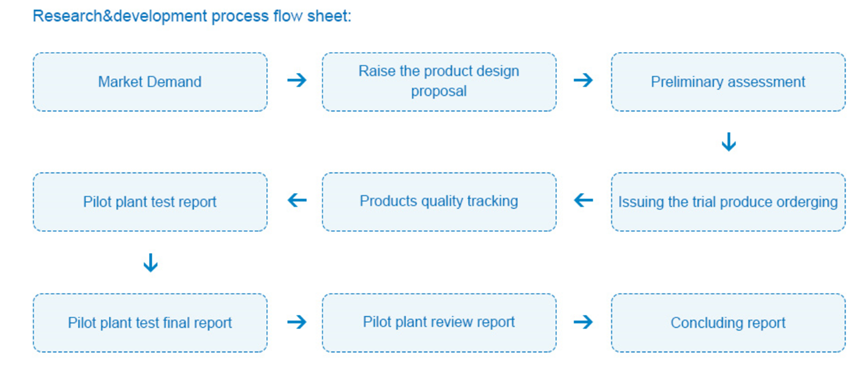
We have assembled a powerful research and development team, comprising 20 professors and 25 senior engineers. Led by a Technical Director with more than a decade of experience in lithium-ion battery development, our commitment to innovation keeps us at the forefront of the market.
FAQ
Q:
What is the recommended storage voltage for Lipo batteries?
A:
Recommended storage voltage for battery cell is 3.8V to 3.85V.For battery pack, for example 6s 22.2V, the suggested storage voltage is 22.8V to 23.1V.
Q:
What is best temperature for Lipo battery storage?
A:
We advise store in a cool place. The ideal temperature range is between 20°C and 25°C (68°F and 77°F). This storage temperature range helps Lipo batteries maintain good stability and longevity.
Q:
How long could we store Lipo battery sit unused?
A:
Once at the correct storage voltage and temperature, a LiPo battery can be stored for months without issue. It is good practice to check the voltage every 3 to 6 months. If the voltage has dropped significantly (e.g., below 3.7V per cell), give it a small charge to bring it back to 3.8V.
Q:
How to store Lipo batteries physical safely?
A:
Here are some advice to store lipo batteries physical safely:
● Use a Fireproof Container: Store LiPos in a Safe Bag, an ammunition box (metal), or a ceramic pot.
● Check Physical Condition: Never store a battery that is puffy (swollen), dented, or has torn outer wrapping. If a battery is damaged, it should be disposed of properly, not stored.
● Separate Terminals: Ensure the main leads and the balance leads do not touch each other. It is best practice to cover the main plug ends with silicone caps or electrical tape to prevent a short circuit.
Q:
What is the energy density for a battery?
A:
Energy density is a fundamental specification that measures how much energy a battery can store relative to its size or weight. It is the primary factor determining how long a device can run or how far a vehicle can travel on a single charge.
There are two distinct ways to measure energy density, and it is important not to confuse it with "power density."
The energy density is a function of the battery's chemistry and design. It can be calculated using the cell's voltage and capacity:
● Specific Energy (Wh/kg) = (Nominal Voltage × Specific Capacity) / 1000
● Energy Density (Wh/L) = (Nominal Voltage × Volumetric Capacity) / 1000
Comparison of Specific Energy (Wh/kg)
This chart shows how much energy different batteries store per kilogram of weight. Lithium-based batteries (Li-ion, LiPo) lead the pack, which is why they dominate the drone and EV markets.
|
Battery Type |
Specific Energy (Wh/kg) |
|
Lead-Acid |
30–50 |
|
Ni-MH |
60–110 |
|
Li-ion / LiPo (General) |
100–265 |
|
High-Performance LiPo (e.g., Kokam cell) |
211 |
|
Tesla 4680 (NMC811) |
241 |
|
BYD Blade (LFP) |
160 |
Comparison of Volumetric Energy Density (Wh/L)
This chart shows how compact the energy storage is. Notice how Lithium-ion has an extremely wide range (250–730 Wh/L), allowing for very slim phone batteries or powerful yet compact drone packs.
|
Battery Type |
Volumetric Density (Wh/L) |
|
Lead-Acid |
50–100 |
|
Ni-MH |
120–300 |
|
Li-ion / LiPo |
210–730 |
|
Tesla 4680 |
643 |
Summary for Your Context
For UAV batteries (LiPo) :
● They typically achieve 100–265 Wh/kg.
● The trend in the industry is to push these numbers higher to achieve longer flight times without increasing weight
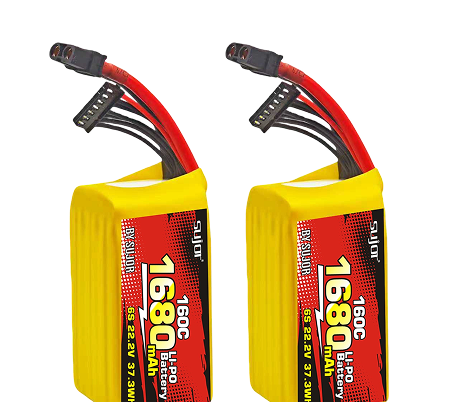
SUJOR aims to provide customers tailored lithium ion battery packs. We could not only provide customers with customized services for individual components such as battery cell, BMS and battery structure, but also offer optimal battery integrated solutions (cell+BMS+structure) based on customer’s detailed requirement.