News
Apr. 10, 2026
Share:
Understanding the difference between these two terms is key to speaking accurately about the low-altitude economy. While they are often used interchangeably in casual conversation, they have distinct technical meanings.
The simplest way to put it is: A UAV is a single component, while a UAS is the entire system that makes the UAV work.
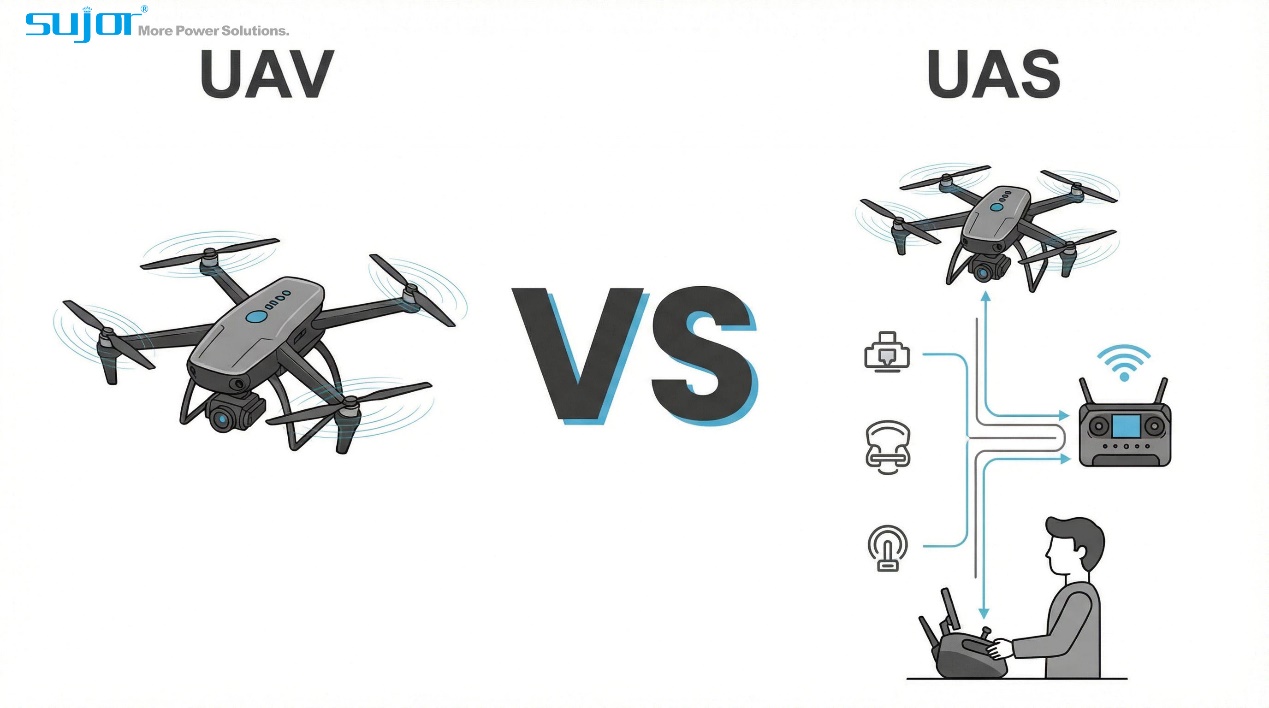
Here is a breakdown of the differences:
|
Feature |
UAV (Unmanned Aerial Vehicle) |
UAS (Unmanned Aircraft System) |
|
Definition |
The flying vehicle itself. |
The complete system that operates the UAV. |
|
Analogy |
An airplane, without a pilot or ground crew. |
An airline, which includes the airplane, the pilot, the ground crew, and the control tower. |
|
Scope |
Narrow (a single component). |
Broad (an interconnected system). |
|
Key Components |
The airframe, engines/propellers, sensors, and onboard computer. |
The UAV, the Ground Control Station (GCS) , and the Communication Link (data link). |
Breaking It Down
Why the Distinction Matters
Using the term UAS is important for safety, regulation, and professional operations, especially in the context of the low-altitude economy we just discussed.
conclusion
In summary, while the general public and media will likely continue to use the word "drone" or "UAV," professionals and regulators use UAS to emphasize the complexity and interconnected nature of the technology. In our previous discussion about the low-altitude economy, when we talked about challenges like "airspace management" and "communication networks," we were fundamentally talking about the challenges of integrating thousands of UAS, not just the UAVs themselves.
Related Products

SUJOR aims to provide customers tailored lithium ion battery packs. We could not only provide customers with customized services for individual components such as battery cell, BMS and battery structure, but also offer optimal battery integrated solutions (cell+BMS+structure) based on customer’s detailed requirement.