News
Apr. 10, 2026
Share:
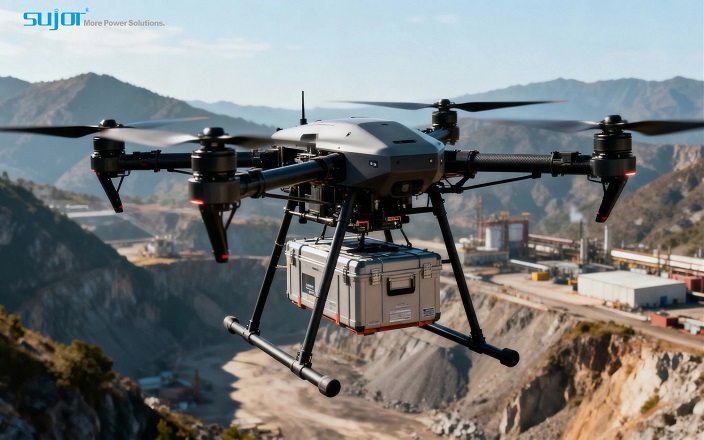
Choosing batteries for a 100kg–200kg payload drone is a critical task that balances power, safety, and flight time. For drones of this scale, you are essentially designing a mobile power plant, and the battery is its heart. Your primary choice will be high-voltage Lithium Polymer (LiPo) packs, with emerging solid-state technologies offering a glimpse into the future.
Here are the key parameters you must evaluate to make the right choice.
The Core Selection Criteria
Selecting a battery involves carefully weighing several key specifications. The table below breaks down what you need to consider for each.
|
Parameter |
Why It's Critical |
Typical Range for 100-200kg Payload |
Key Considerations |
|
Voltage (V) |
Higher voltage systems are more efficient, reducing current draw and heat for the same power output. |
12S (44.4V) to 24S+ (91.2V+) |
Must match your drone's motors and ESCs. Common configurations are 14S (51.8V) for 70-100kg drones and 18S (66.6V) for heavier lifts. |
|
Capacity (Ah) |
Dictates your total stored energy and directly impacts flight time. |
20,000 mAh (20Ah) to 60,000 mAh (60Ah) per pack |
Higher capacity adds significant weight. It's a trade-off: more battery weight means less payload or shorter flight time. Calculate based on your drone's average current draw. |
|
Discharge Rate (C-Rating) |
The battery's ability to deliver the enormous, instantaneous current needed for takeoff and sustained heavy lift without voltage sag or damage. |
15C to 35C continuous |
This is a critical safety parameter. A higher C-rating ensures the battery can handle peak power demands. For example, a 30Ah battery with a 35C rating can safely deliver 1050A continuously (30Ah * 35C). |
|
Chemistry |
Determines the fundamental trade-off between energy density, power delivery, safety, and cycle life. |
Lithium Polymer (LiPo) |
The industry standard. Excellent high discharge rates and energy density. Requires careful handling and management. |
|
Semi-Solid State / Solid-State |
Emerging technology. Offers higher energy density (up to 400Wh/kg) and improved safety, but is less available and more expensive currently. |
Key Features for Heavy-Lift Operations
Beyond the basic specs, the best batteries for this demanding application include advanced features to ensure safety and reliability:
• Smart Battery Management System (BMS): An integrated BMS is non-negotiable. It constantly monitors cell voltages, temperature, and overall health, protecting against overcharge, deep discharge, and short circuits. It communicates this data to the pilot, providing critical real-time insights.
• Robust Physical Design: Look for batteries with aluminum housings for superior heat dissipation and structural protection. Features like waterproofing, anti-spark connectors, and efficient mounting systems (e.g., slide-in installation) are also vital for safe and reliable field operations.
High Power and Fast Charging: Heavy-lift drones often require high continuous current, e.g., 270A to 360A or more. To minimize downtime between flights, some advanced batteries support 5C fast charging, drastically reducing charge times
Checklist for Your Selection Process
To ensure you choose correctly, follow this step-by-step checklist:
1. Match Voltage First: Verify your drone's motor and ESC voltage rating and select a battery with the correct cell count (e.g., 12S, 14S, 18S).
2. Calculate Power Needs: Estimate your drone's average and peak current draw. Ensure the battery's continuous C-rating can handle the peak draw with a safety margin.
3. Prioritize Safety and Intelligence: Option for a battery with a built-in BMS and robust physical casing. This is critical for protecting your investment and ensuring operational safety.
4. Balance Capacity and Weight: Determine the minimum capacity needed to achieve your target flight time. Adding more capacity increases weight, which could reduce your available payload
Related Products
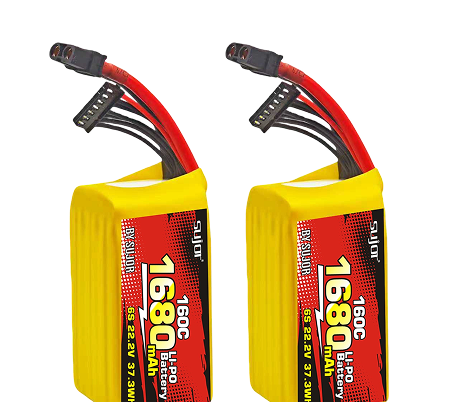
SUJOR aims to provide customers tailored lithium ion battery packs. We could not only provide customers with customized services for individual components such as battery cell, BMS and battery structure, but also offer optimal battery integrated solutions (cell+BMS+structure) based on customer’s detailed requirement.