News
Apr. 10, 2026
Share:
The low-altitude economy is experiencing a dynamic and rapid rise, transitioning from conceptual validation to large-scale commercial application at an accelerated pace. The current state of this sector can be understood through several key dimensions:
📈Market Scale:
The low-altitude economy has already formed a considerable market scale, projected to reach 1.5 trillion yuan in 2025, with expectations to hit 2 trillion yuan by 2030 and potentially 3.5 trillion yuan by 2035. The sector is also witnessing a surge in orders for eVTOL (electric Vertical Take-off and Landing) aircraft, with some companies securing over 1,700 orders and contracts totaling billions of yuan.
✈️Core Progress:
The industry has moved beyond simply "getting airborne" to a critical phase of "practical application". This is evident in the commercialization of eVTOL aircraft, with 2026 identified as a pivotal year for airworthiness certification and commercial launch. Key progress points include the 2026 Spring Festival Gala showcasing 22,580 drones and an eVTOL Water airport . Furthermore, "air taxis" are now a reality, with helicopter routes connecting cities like Shanghai, Zhejiang, and Jiangsu during the Spring Festival travel rush. The legal framework has also been strengthened with the first major revision of the Civil Aviation Law, set to take effect in July 2026.
🚀Application Expansion:
The low-altitude economy is rapidly expanding into diverse sectors. In logistics, drones enable "minute-level" intercity delivery and transport medical samples across hospitals, significantly reducing wait times. For agriculture, drones overcome geographical barriers to transport local specialties out of remote mountainous areas. Urban air mobility is also taking shape, with plans for over 50 low-altitude routes in the Yangtze River Delta during the "15th Five-Year Plan" period.
🏛️Policy Support:
A robust multi-level policy framework is actively supporting this growth. Nationally, five ministries issued an opinion to strengthen information and communication industry capabilities, setting a 2027 target of over 90% network coverage for low-altitude public airways. The National Development and Reform Commission has also established a dedicated department for low-altitude economic development. Local governments are contributing by formulating specialized policies and establishing low-altitude economic demonstration zones.
⚙️ Challenges:
Despite rapid growth, the industry faces several hurdles. The supply chain requires further investment from top-tier suppliers for customized R&D. There is also an acute shortage of professionals with airworthiness certification and engineering experience. Moreover, developing comprehensive supporting infrastructure and management systems remains a work in progress.
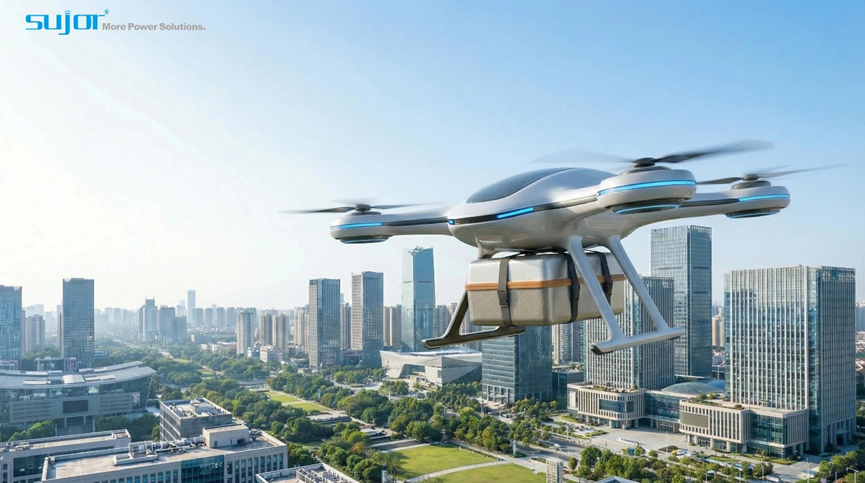
Overall, the low-altitude economy in China is on a robust upward trajectory, marked by significant market potential, accelerating commercialization, expanding applications, and strong policy backing, although it must navigate challenges related to supply chains, talent, and infrastructure.
Related Products

SUJOR aims to provide customers tailored lithium ion battery packs. We could not only provide customers with customized services for individual components such as battery cell, BMS and battery structure, but also offer optimal battery integrated solutions (cell+BMS+structure) based on customer’s detailed requirement.