FAQ
One-stop answers to the most common questions about battery technology, usage, and maintenance.
FAQ
Find answers to the most common questions about battery technology, usage, and maintenance — all in one place.
Q:
Can I use any charger to charge my drone battery?
A:
It is important to use a charger specifically designed for your drone battery to avoid damaging the battery or the drone. Using the wrong charger may lead to overcharging, undercharging, or other issues that could shorten the battery's lifespan or cause a battery failure. Always use the charger that came with the drone or a compatible charger recommended by the manufacturer.
Q:
How long does it take to charge a drone battery?
A:
The time required to charge a drone battery depends on several factors, including the battery's capacity, the charger's output power, and the battery's current charge level.
For example, a battery with a capacity of around 1000mAh may take approximately 30 to 60 minutes to fully charge using a standard charger. However, larger batteries with capacities of 5000mAh or more may require several hours to charge completely.
Some drone batteries are equipped with fast chargers, which can significantly reduce charging time. These chargers can recharge the battery in as little as 15 to 30 minutes, though frequent use of fast charging may shorten the battery's overall lifespan.
Q:
What is the voltage of a UAV Lipo battery cell?
A:
Every LiPo cell has three important voltage levels :
Nominal Voltage: 3.7V (The standard "average" voltage used to describe the battery).
Fully Charged Voltage: 4.2V (The maximum voltage right after a full charge).
Discharge Cutoff Voltage: 3.0V (The minimum safe voltage; going below this can damage the battery).
Note: There are also High Voltage (HV) LiPo batteries, where the fully charged voltage per cell is higher, typically 4.35V, 4.4V, or even 4.45V.
Hot tags: Lipo battery, lithium polymer battery, high rate lipo battery, high rate battery, high C rate battery, high voltage battery(HV/LiHV), Low temperature battery, long cycle life battery
Q:
What is the recommended storage voltage for Lipo batteries?
A:
Recommended storage voltage for battery cell is 3.8V to 3.85V.For battery pack, for example 6s 22.2V, the suggested storage voltage is 22.8V to 23.1V.
Q:
What is best temperature for Lipo battery storage?
A:
We advise store in a cool place. The ideal temperature range is between 20°C and 25°C (68°F and 77°F). This storage temperature range helps Lipo batteries maintain good stability and longevity.
Q:
How long could we store Lipo battery sit unused?
A:
Once at the correct storage voltage and temperature, a LiPo battery can be stored for months without issue. It is good practice to check the voltage every 3 to 6 months. If the voltage has dropped significantly (e.g., below 3.7V per cell), give it a small charge to bring it back to 3.8V.
Q:
How to store Lipo batteries physical safely?
A:
Here are some advice to store lipo batteries physical safely:
● Use a Fireproof Container: Store LiPos in a Safe Bag, an ammunition box (metal), or a ceramic pot.
● Check Physical Condition: Never store a battery that is puffy (swollen), dented, or has torn outer wrapping. If a battery is damaged, it should be disposed of properly, not stored.
● Separate Terminals: Ensure the main leads and the balance leads do not touch each other. It is best practice to cover the main plug ends with silicone caps or electrical tape to prevent a short circuit.
Q:
What is the energy density for a battery?
A:
Energy density is a fundamental specification that measures how much energy a battery can store relative to its size or weight. It is the primary factor determining how long a device can run or how far a vehicle can travel on a single charge.
There are two distinct ways to measure energy density, and it is important not to confuse it with "power density."
The energy density is a function of the battery's chemistry and design. It can be calculated using the cell's voltage and capacity:
● Specific Energy (Wh/kg) = (Nominal Voltage × Specific Capacity) / 1000
● Energy Density (Wh/L) = (Nominal Voltage × Volumetric Capacity) / 1000
Comparison of Specific Energy (Wh/kg)
This chart shows how much energy different batteries store per kilogram of weight. Lithium-based batteries (Li-ion, LiPo) lead the pack, which is why they dominate the drone and EV markets.
|
Battery Type |
Specific Energy (Wh/kg) |
|
Lead-Acid |
30–50 |
|
Ni-MH |
60–110 |
|
Li-ion / LiPo (General) |
100–265 |
|
High-Performance LiPo (e.g., Kokam cell) |
211 |
|
Tesla 4680 (NMC811) |
241 |
|
BYD Blade (LFP) |
160 |
Comparison of Volumetric Energy Density (Wh/L)
This chart shows how compact the energy storage is. Notice how Lithium-ion has an extremely wide range (250–730 Wh/L), allowing for very slim phone batteries or powerful yet compact drone packs.
|
Battery Type |
Volumetric Density (Wh/L) |
|
Lead-Acid |
50–100 |
|
Ni-MH |
120–300 |
|
Li-ion / LiPo |
210–730 |
|
Tesla 4680 |
643 |
Summary for Your Context
For UAV batteries (LiPo) :
● They typically achieve 100–265 Wh/kg.
● The trend in the industry is to push these numbers higher to achieve longer flight times without increasing weight
Q:
What is a 5 inch FPV drone?
A:
A 5-inch FPV drone is a type of first-person-view quadcopter that uses 5-inch propellers. It is widely considered the "goldilocks" size in the FPV world—offering the best balance of agility, speed, and flight time, making it the most popular choice for both racing and freestyle flying
Q:
What are the common components for a 5-inch drone?
A:
A 5-inch drone is almost always built from modular components, allowing pilots to customize their "build." Based on product listings and guides, the typical parts include:
● Frame: Carbon fiber, H or Deadcat style.
● Motors: 19xx-22xx series (e.g., 2207, 2306).
● Battery: 4S (14.8V) or 6S (22.2V) LiPo, usually 1300-1800mAh.
● Flight Controller: F7 or H7 chipset
Related Products
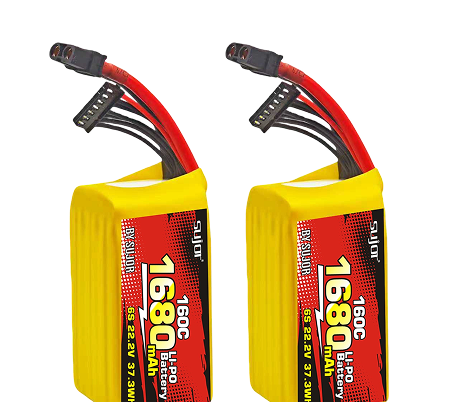
SUJOR aims to provide customers tailored lithium ion battery packs. We could not only provide customers with customized services for individual components such as battery cell, BMS and battery structure, but also offer optimal battery integrated solutions (cell+BMS+structure) based on customer’s detailed requirement.